Saturday, September 13, 2014

His Story is a Nightmare From Which I am Trying to Awaken (with apologies to Stephen Dedalus)


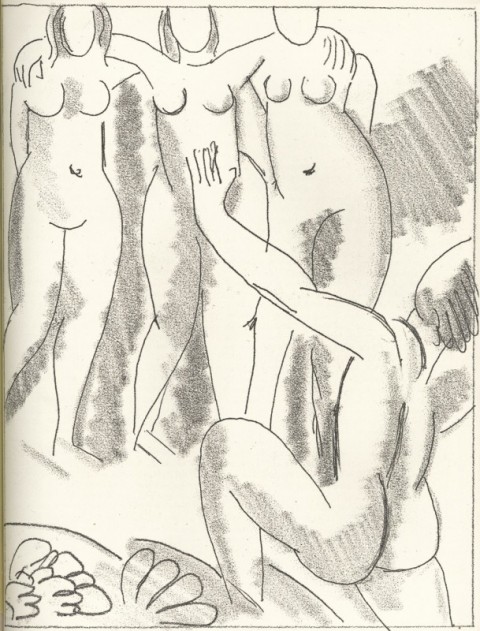
I have my different phases with Joyce. I am often content to just sit back and admire his marvelous inventiveness, his sly humor, his virtuosity and, yes, I said yes, his genius. Other times, I feel both compassion for his suffering and admiration for his tremendous perseverance, feelings I definitely had in my recent reading of The Most Dangerous Book: The Battle for James Joyce’s Ulysses by Kevin  Birmingham. But running along as another undercurrent to my Joycean musings I also frequently feel a sense of alienation. Every once in a while it comes  right up to the surface, as it did at our latest Wake reading the other night. Afterwards, I was trying to remember what set me off this time, and realized that it was his whole raven/dove dichotomy as related to the feminine. Frankly, it just bugged the hell out of me.

First off, I don’t really have a huge taste for these kinds of polarities. I don’t like ravens being the symbol for dark, the sinister, or any of the underworld side of things. Ravens are smart and resourceful and are a lot more like us than we probably realize, and it’s a bum rap to cast our own shadow on to them. Doves, despite being appropriated by Christian iconography are probably mean and vicious sometimes themselves. I get a little tired of doves, rabbits, lambs all being the symbols of innocence when they’re actually a bit on the dim side.

Anyway.  Joyce and women. I really don’t buy his take at all. I have virtually no empathy for Molly Bloom, patron saint of the affirmative way of life though she well may be, and find Leopold Bloom himself much more a kindred spirit than his lie-abed counterpart. I mean, don't we all? Isn't that why we read Ulysses in the first place? Leopold Bloom, c'est moi?

As far as the Wake goes, well, Izzy is all right, in her dovelike, lamblike, cloudlike way, but ALP, the river, the past present future, fecundity, etc., I don’t get her. I know she’s not exactly meant to be a naturalistic figure of course, but it’s exactly in Joyce’s mythologizing of the feminine where I tend to run afoul of him. It’s not just an ideological disagreement. It's more visceral. The best I can say is that I start to feel in a trap or a bind, like I’m caught inside his way of seeing, and I feel like flailing against the bars. I find myself wanting what is outside his mind. Reality as it is not known, or dreamt of in the philosophies of James Augustine Aloysius Joyce. I want the feminine equivalent of Joyce to represent reality from her own point of view.  

I bring this all up not just to rehash my rant yet again, but because just now, today, I seem to have been presented with a partial possible answer to that. I came across a glowing Slate book review on a novel called A Girl is A Half-Formed Thing by Eimear McBride, and if you think that the book owes a little bit to Joyce himself, you’d be right, as she had a quote from Joyce’s letters taped above her desk as she wrote it:

“One great part of every human existence is passed in a state which cannot be rendered sensible by the use of wideawake language, cutanddry grammar and goahead plot.”

A woman novelist’s response to Joyce in his own sort of vernacular? This is either a case of “Ask and it shall be given.” or “Be careful what you wish for.”  In any case, I’ve ordered the book. I’ll let you know how it goes.
Friday, September 12, 2014

My Review of The Most Dangerous Book at Escape Into Life

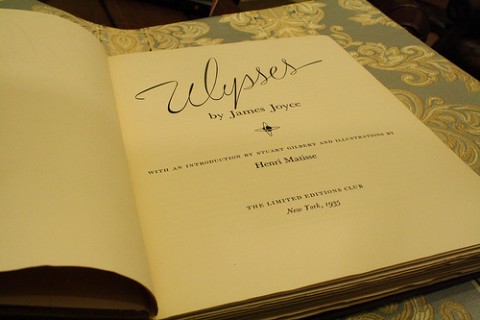
I was fortunate recently to have fellow Waker Leslie lend me her copy of The Most Dangerous Book: The Battle for James Joyce's Ulysses by Kevin Birmingham and have just posted my review at the website Escape Into Life. I haven't really come across that many books in my life that really help you connect so many dots, and even if it isn't strictly about Finnegans Wake, I do highly recommend it.

Tuesday, August 26, 2014

Excellent Discussion on Literary Modernism and Joyce

http://radioopensource.org/the-shock-of-the-new/

Guest List

• Howard Eiland, modernist scholar, editor of the modernist philosopher, Walter Benjamin, and author of the biography Walter Benjamin: A Critical Life.
• Eve Sorunprofessor of English at the University of Massachusetts, Boston, currently writing a book on empathy and elegy in British modernism.

Thursday, June 19, 2014

New Yorker's Bloomsday Article: “ULYSSES” AND THE MORAL RIGHT TO PLEASURE

...Coming to terms with “Ulysses” inevitably means realizing what Joyce had to overcome when he brought it into the world—first in writing it, then in finding a publisher, and, finally, in getting it printed....Joyce was writing the novel knowing that to publish it was nearly impossible, and likely illegal. ...

http://www.newyorker.com/online/blogs/books/2014/06/ulysses-joyce-moral-right-to-pleasure.html

Monday, June 2, 2014

Page 335--haka

I want to say my fellow Wakers were impressed by desire to share sports lore in reference to the Wake, but I think the better word would probably be 'flabbergasted' or 'dumbfounded'. Sports isn't really my particular métier. Nevertheless, when I learned from John P. Anderson's multivolume work on Joyce's Finnegans Wake: the Curse of Kabbalah that there was a haka coming up in the pages we were about to discuss, I was quite excited. I had learned about hakas from Adrian McKinty's excellent blog.They were and are Maori war chants, but have also have been incorporated into the opening of rugby games.

Here is an example of New Zealand's fearsome team the All Blacks doing one:


Now, it turns out that this very same team came to Paris in 1925 and were so formidable that they were nicknamed the Invincibles. A new haka called Ko Niu Tereni was written on the voyage over from New Zealand and this is what Joyce heard when he came to the Paris game.


Kia whakangawari au i a hauLet us prepare ourselves for the fray
I au-e! Hei!(The sound of being ready)
Ko Niu Tireni e haruru nei!The New Zealand storm is about to break
Au, Au, aue hā! Hei!(The sound of the imminent storm.)
Ko Niu Tireni e haruru nei!The New Zealand storm waxes fiercer
Au, Au, aue hā! Hei!(Sounds of The height of the storm.)
A ha-ha!
Ka tū te ihiihiWe shall stand fearless
Ka tū te wanawanaWe shall stand exalted in spirit
Ki runga ki te rangi,We shall climb to the heavens
E tū iho nei, tū iho nei, hī!We shall attain the zenith the utmost heights.
Au! Au! Au!

According to Wikipedia, there was a second verse, but as this had to do with friendship between teams, it was of course quickly scrapped.


Joyce understandably was intrigued by both the display of ferocity and the words and wanted to incorporate these into his book in some way. As luck would have it, he had a source in New Zealand, none other than his own sister, who had moved there when she became a nun. So he wrote her and asked her for the words and she apparently got a version out of the newspaper to him.


And so, eventually, the Wakian haka, the last part more hakian than the first (page 335):


Au! Au! Aue! Ha! Heish! ... how Holispolis went to Parkland with mabby and sammy and sonny and sissy and mop's varlet de shambles and all to find the right place for it by peep o'skirt or pipe a skirl when the hundt called a halt on the chivvychace of the ground sloper at that ligtning lovemaker's thender apeal till, between wandering weather and stable wind, vastelend hosteilend, neuziel and oltrigger some, Bullyclubber burgherly shut the rush in general.
Let us propel us for the frey of the fray! Us, us, beraddy!
Ko Niutirenis hauru leish! A lala! Ko Niutirenis haururu laleish! Ala lala! The Wullingthund sturm is breaking. The sound of maormaoring The Wellingthund sturm waxes fuercilier. The whackawhacks of the sturm. Katu te ihis ihis! Katu te wana wana! The strength of the rawshorn generand is known throughout the world. Let us say if we may what a weeny wukeleen can do.
Au! Au! Aue! Ha! Heish! A lala!

There is a good article on all this by Dean Parker of the New Zealand Herald HERE.


John P. Anderson also has some very interesting stuff on this, but maybe I'll make that another post.

Tuesday, May 27, 2014

Thornton Wilder--Joyce scholar?

PQ, leader and chronicler of the Austin Wake group on his blog Finnegans, Wake!, has sent a couple of leads on a (to me) previously unknown fact--playwright Thornton Wilder was a Wake enthusiast. I thought I would put up the links PQ gave us in the comments field so that others can enjoy them as well. I was quite surprised to see an article by Joseph Campbell and Henry Morton Robinson in a Saturday Review of December, 1942, showing how Wilder had lifted much material for his play The Skin of OurTeeth straight out of Finnegans Wake. Campbell and Robinson declare themselves perplexed by the lack of acknowledgement. I suspect that Joyce, greatest lifter of them all, would not be. It's kind of fun to see the pair described as working on something called "A Skeleton Key to Finnegans Wake", which subsequently became a book that we have availed ourselves of no end.


I have seen The Skin of Our Teeth at least once but have never thought of it in relation to the Wake--though it seems obvious enough now.


If homage was owed, then Wilder made amends in this rather brilliant analysis of a segment of the book that we haven't reached yet, which (among other things, it goes without saying) seems to depict the death by burning of Giordano Bruno. I have a great affection and sympathy for Bruno of Nola, which is really down to Joyce, although helped along by a well written mystery series by S. J. Parris featuring the exiled monk as a detective.


Here's a little bit about both Joyce's intent and his effect in the Wake, which I must say rings true for me.


"The first impression one receives is that it is a work of comic intention, for verbal distortions always appear to us as proceeding from wit, even when they arise from the unconscious; but though there are innumerable puns in the novel, Joyce's interest is not primarily in the puns but in the simultaneous multiple-level associations which they permit him to pursue. Finnegans Wake appears to me as an immense poem whose subject is the continuity of what is Living, viewed under the guise of a resurrection myth. This poem is conducted under the utmost formal rigor controlling every word and in a style that enables the author through apparently preposterous incongruities to arrive at an ultimate unification and harmony."

Thanks, Thornton.