Sunday, July 25, 2010

A new chapter--pages 126-128

 Okay, just to start off, I found two funny things in the course of finding a little background info. One was on a site where you could download The Wake, and it cautioned, "Do not spell-correct this document". (But wouldn't it be fun to try?) On the same site's sponsoring ads it promises, "Get Joyce's email address." I couldn't resist clicking through, but it was disappointing...

So we've now arrived in the sixth chapter of the first book. Whether reaching these milestones actually means anything, I don't know, but we always do feel a bit elated at having come so far. Also, we've apparently left the close discussion of ALP's letter and have now entered the realm of riddles. This chapter consists of twelve riddles, which are asked and answered. Supposedly, they give us more details of the life of both the major and minor characters of the novel.

We got into a brief discussion about riddles. I don't think any of us said that we particularly liked them, but we did remember how they show up in different classic tales as important--the Sphinx in Oedipus has a famous one, and L. recalled that Wotan has another in Wagner. The appeal of riddles, however, remains mysterious, at least to me. Kids' riddles are funny, at least the first time, but the kinds of riddles that turn up in literature tend to be very solemn and fateful, and often, as a modern reader or listener, we tend to quibble with the answers. Nevertheless, we all felt that that there must be some nugget at the heart of them, and Joseph Campbell in the Skeleton Key reminded us that the ancient gods often fought with riddles, not weapons.

We may have deprived ourselves of some suspense, though. We accidently looked ahead and learned the answer to the first one! And I'm going to tell it here too, but not till the end of this post. Still, with the Wake it may be as well to have the answer before starting out-- after all, there's not much certainty that you are going to  come to it on your own.

Having the Wake right here on another tab of the computer is a different experience of reading it. Not better or worse, just different. It makes me realize that we read it as if we are trying to get through something, rather than as if each fragment will disclose some meaning. It's hard to say that we read too fast by any other standards, but it may be true. And I don't mean because then we could succeed at picking apart every meaning, but because on some level it is actually poetry, such as this phrase that stands out to me now: "towers, an eddistoon amid the lampless, casting swannbeams on the deep".

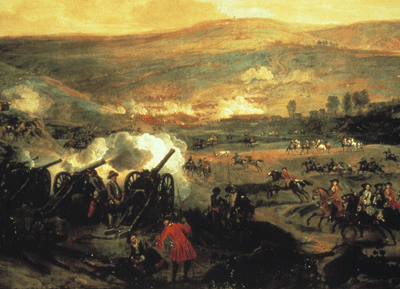
But I should perhaps get to a few things we did pick out together. A phrase that caught our attention was, "like a heptagon crystal emprisoms trues and fauss for us", which we feel has something to do the way a prism captures true and false, but also 'phosphorus'. Oh, and just before that, a real 'riddly' part: "is too funny for a fish and has too much outside for an insect". We puzzled over the the acronym F.E.R.T., which our mysterious subject wrote on his buckler, and which the above photo demontrates. It turns out to be the motto of the House of Savoy, although it would seem to be a funny kind of motto, as no is absolutely sure of it's significance, although some theories are posted here. Personally, I like the parodic one, supposedly based on the Savoys' tendency to raid anyone showing the slightest vulnerability: Frappez, Entrez, Rompez Tout (French: "Strike, Enter, Break Everything") With it's vague suggestiveness of Here Come Everyone, I'm guessing Joyce might have liked it too.

We also liked this,

business, reading news-

paper, smoking cigar, arranging tumblers on table, eating meals,
pleasure, etcetera, etcetera, pleasure, eating meals, arranging tum-
blers on table, smoking cigar, reading newspaper, business; 
minerals, wash and brush up, local views, juju toffee, comic and
birthdays cards;

because it reminded us of Bloom doing his daily rounds in Ulysses.

And I personally liked "can dance the O'Bruin's polerpasse at Noolahn to his own orchistruss accompaniment" because of our previous introduction to the plays on both Bruno of Nola, or Giordano Bruno, and Brown and and Nolan, the booksellers who first published him in Dublin.


Wel, that's plenty long for this post, and I'm sorry for what I've already forgotten.
It was also fun reading about these particular pages here. He really packs it in, does our Jim Joyce. But by now, that's hardly surprising.

Oh, right. The answer to the first riddle is Finn McCool. Make of that what you will.

Thursday, July 22, 2010

A week behind, but meanwhile...

I should have posted about last week's meeting by now, but felt hindered by the fact that I can't at the moment find my book. Now that I see the relevant pages on line, I will dispatch the job shortly. However, here's bit  on Joyce's esthetic from A Building Roam that is surely more worthwhile reading for anyone serious about Joyce than any yammerings from this blogger.

Sunday, July 4, 2010

Pages 123-125--end of a chapter

Before we leave the Tunc page behind, which we seem to be doing, I thought I'd mention a link to an excellent blog post on the matter from the blog A Building Roam, which goes into much more depth about the page itself. It also links to a piece on a new way of reading Finnegan that might make it more accessible, which is basically from the inside out, apparently from just about the spot we are now. Nice if it happens to be true. I'm also a bit embarrassed to find that it points out the cover of Campbell's Skeleton Key to Finnegans Wake is in fact the T from the Tunc page. And no, I never noticed,  even though this is the main source I'm thumbing through during our meetings.

We only had three members present this time around, so it seemed fitting that we just work through three medium long paragraphs together. It turned out to be more than enough. One thing that C. keeps reminding us of, after reading Ellman's thorough biography of Joyce's life, is that in a broad sense, Ulysses represents the day and Finnegans Wake the night. She is becoming very good at seeing how the things we are reading are parallel to portions of Ulysses, but seen through the lens of the unconscious. Something in the way she said this reminded me of what Jacques Barzun, in his history of modern times From Dawn to Decadence said about the characteristics of our era, but in this case particularly analysis and self-consciousness. It's as if our present way of thinking prefers to sharpen detail, we want everything etched out in the bright light of day, but Finnegan shows us the shadow world, which doesn't necessarily distinguish even between persons.

One thing I thought I'd comment on here is a brief sentence or fragment of a sentence, because it illustrates some of the way in which Joyce's mind works: "the circumflexuous wall of a singleminded men's asylum, accentuated by bi tso fb rok engl a ssan dspl itch ina". So there is a wall, bending around a men's asylum--although, as came up in our discussion, we don't really know if the asylum is to keep the men in, or to keep the women out. In any case, the broken glass and china that accentuate this wall, or I'd guess, make it a little harder to get over than it would be, is represented by words that are themselves broken up, which I like very much.

One thing I discovered in trying to shed a little more light on these pages is a short excerpt from Modern Language Notes, John Hopkins, February 1960, which seemed a very nice description of the experience of trying to read the Wake.

Deliberate obscurity is a central feature of his art; we hear a distorted whisper, the indistinct murmur of sleeping men. We move in a thick fog, and the outline of persons and events is blurred and hardly recognizable. Sometimes the fog rolls away, and we dimly perceive something, but next moment we are in the dark again, and painfully grope our way forward. This creates a painful, but also exhilerating tension. 

This description echoes a bit with my sense, which I tried to articulate last week, of  how we are well-educated enough to get a reference here or there, but it's like picking out a few glimmers in a vast sky. And we all know a slightly different set of facts. What's funny, or perhaps even apt, is that this is so similar to what Joyce is saying about the hen picking out little pieces of this and that from the "dump" of civilization. And perhaps realizing that we have but glimmers is a way of glimpsing how vast are the glories of the whole.


   Next time we're on to Chapter 6, which is apparently all about Four Old Men who pose a series of riddles...

Sunday, June 20, 2010

Pages 119-123--the Tunc page

Though we were down a person at our last meeting, we nevertheless had a lovely time, due to the guest appearance of one of our member's parents. Their willingness to just drop in at page 119 is  a tribute both to their being good sports and to the paradoxical openness of a book that is famous for its inaccessibility. We had a chance to describe "what we've learned so far", and they were actually inspired to contemplate starting a Finnegans Wake reading chapter of their own.

As I said last time, this next part focuses on the Book of Kells, particularly the Tunc page, which reads Tunc crucifixerant Xpi cum eo duos latrones, and  means "Then were there two thieves crucified with him." One of the things we learned was that Joyce was basically riffing off of and having fun with (or making fun of) a famous commentary on the book done by one Edward Sullivan. You can read his introduction here.

I learned a lot from perusing a few pages of a book called The Books at the Wake: a Study of Literary Allusions in James Joyce's Finnegans Wake by James S. Atherton. One is to be on the watch for puns on the name of the founder of the monastery where the Book of Kells was produced. St. Columba actually first appears on is also known as Colum Cille, so mentions of "Hagios Colleenkiller"  and "Calomnekiller" are plays on that name. That last comes from the first mention of the Book of Kells on page 50. As Atherton has it, this is "all the French leaves unveilable out of Calomnequiller's Pravities." He says that "French leaves" means "missing leaves", and there are 60 pages missing from the manuscript, but it also means "obscene pages" "the depravities of which can not be veiled or concealed." Atherton thinks "Pravities" comes from "pravus" or crooked, depraved and Calomnequiller lends it to "writer of calumnies". The point being that The Book of Kells "like all acts of creation..has something sinful about it". This, from my admittedly limited understanding, seems a very Joycean concept. Atherton also points out an anagram in Tunc, which Joyce was most certainly aware of.

I've strayed from our meeting though, where, for instance, at least a couple of people knew what the meaning of 'ineluctable' was and still others pointed out that it was from a very famous phrase in Ulysses--"...the ineluctable modality of the audible". Yeah, I knew that...

Speaking of Ulysses, we had a very nice Bloomsday celebration. You can read about one of its more appetizing aspects here.

Thursday, May 27, 2010

Finnegans Wake, pages 117-119


Behind, as usual. Luckily for me, we've got a larger than usual hiatus. Unluckily for me, I will now have to reconstruct a meeting of two whole weeks ago. I think I'll stick to the beginning here, and in a moment explain why.


Yes, as Joyce presciently muses, "we in our wee free state...may have our irremovable doubts as to the whole sense of the lot, the interpretation of any phrase in the whole, the meaning of every word of a phrase so far deciphered out of it". I believe we decided that he was referring to the ever present letter, which in some sense is the book itself and in some sense is  the particular missive of Anna Livia Pluribelle or ALP, the feminine principle of the book. Anyway, we found this passage comforting, as this is our constant state in relation to the Wake. Reading it is a great emotional roller coaster, is what it is.

I really like what follows about our knowing of the past or indeed anything (I've taken out some of Joyce's allusions and word play to make the sense clearer, but you have the page numbers, people--go look up what's missing if you want): "On the face of it...the affair is a thing once for all done and there you are somewhere and finished in a certain time...Anyhow, somehow and somewhere...somebody mentioned by name in his telephone directory...wrote it, wrote it all, wrote it all down, and there you are, full stop. O, undoubtably yes, and potably so, but...one who deeper thinks will always bear in the [back] of his mind that this downright there you are and there it is is only in the eye. Why?"

Because, Soferim Bebel [yes, I'll get to that]...every person, place and thing in the chaosmos of Alle...was moving and changing every part of the time.".."He cites "the continually more and less misunderstanding minds of the anticollaborators, and "the variously inflected, differently pronounced, otherewise spelled, changably meaning vocable scriptsigns". With all this flux, he goes on to say "and, sure, we ought really to rest thankful that at this deleted hour of dungflies dawning we have even a written on with dried ink scrap of paper at all to show for ourselves". And indeed we ought.

I have left out almost all of what makes Joyce most Joycean, ie, the word play, just to get the simpler points across. But I did leave in Soferim Bebel, because I happened to find a small passage on that here. Basically, though, the pun is on suffering Babel, and has to do with the destruction of the tower and chaotic world we find ourselves in its aftermath, where all is diffuse and changing and transient, both in ourselves, but also in our language. And that seems a particularly Joycean  way of looking at things.

I'll also note in passing that "Soferim" refers in at least one meaning to a Talmudic treatise on rules on preparing the holy books, as well as rules governing the reading of them. Not so accidental a pun in a book such as this one, I'm thinking.

While looking around for this, I came across this blog entry, which happens to talk about this very passage. What's a bit odd about it is that the author seems to have had high hopes of making an occasional thing, much like this post, but this was one of the only posts of his that I found.


From here, Joyce goes on to obliquely relate things to the Book of Kells, and as there is quite a bit of interplay going on between these two great literary works of Ireland, I thought I'd better do another post around that. (Also, it will give me a bit of time to actually learn a bit more about the famous ancient manuscript.)

Tuesday, May 11, 2010

Finnegans Wake--pages 114-117

It's a bad sign that I'm writing my recollections of the last meeting the day before the next meeting, and I find myself a very unreliable minute keeper. However, this is not a dissertation and reading back over the pages we've just traversed has its own rewards and frustrations. Frankly, it would be better if each member of our little group posted their own account, as I am simply going to seize upon the most obvious thing and let the rest go.

We are still talking in this part about the letter. Joyce has already discoursed upon the importance of  the envelope, which is a funny thing to think about in this age of email. Now Joyce is talking about the signature at the end of the letter or "The teatimestained terminal". (As a little aside, being something we didn't discuss at the group, but something that came up while I just researched to make sure that really did mean the signature, I find that this tiny phrase actually links significantly to the end of the novel, which famously ends in "The". But "the" when appropriately accented is actually the French thé, or tea. As you can see, Joyce was made for graduate students. There is more on all this here.)

Whew. Anyway, the author reminds us, more straightforwardly--and obviously, I live for such moments--both before and after the battle of the Boyne it was a habit not to sign letters always...You have your cup of scalding Souchong, your taper's waxen drop, your cat's paw, the clove or coffinnail you chewed or champed as you wrote it, your lark in clear air. So why, pray, sign anything, as long as  every word, letter, penstroke, paperspace is a perfect signature of its own?


Once again I am reminded that, in the age of email, we are deprived of much, although largely all unconsciously.

Wednesday, April 7, 2010

Finnegans Wake--pages 110-113

Already my memory is a bit hazy on this one. We are apparently back to the hen mentioned early in the story, who at least in part represents the feminine principle, picking away through the ashheap of history, created and I guess destroyed by the masculine principle. I'm not sure I altogether trust Joyce's analysis of the masculine and feminine principles, but never mind, it's quite unlikely that I understand what he's really trying to say.


Here's a good line: "Bethicket me for a son of a beech if I have the poultriest notion what the farest he all means."

As relates to Finnegan, my sentiments exactly.

And here's another: "What bird has done yesterday man may do next year, be it fly, be it moult, be it hatch, be it agreement in the nest."

The agreement in the nest may be stretching it a bit, though...